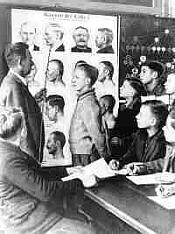
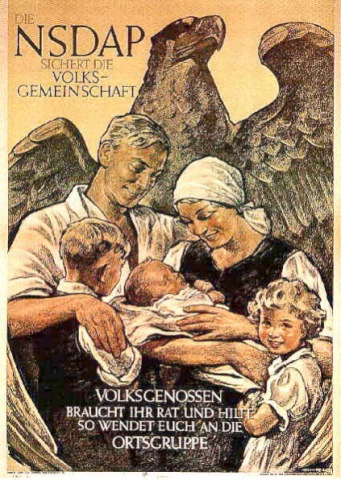
Όλα τα μεταπολεμικά κείμενα περί Εθνικοσοσιαλισμού είναι προφανώς αρνητικά διακείμενα, διότι γράφονται από τα πνευματικά υποχείρια των νικητών σιωνιστών. Ωστόσο αυτό το κείμενο έχει ένα σημαντικό βαθμό αντικειμενικότητας. Παρουσιάζει την φυλετική σκέψη στην Εθνικοσοσιαλιστική Γερμανία.
National Socialism and Race
by Dr. A. James Gregor
Archive Note: This piece, published in 1958, was an early
contribution by an academic now acredited as a significant author upon
the subject of fascism. This essay does not discuss certain peculiar
German Nazi race doctrines which survived into the war period and which
conditioned the movement for eastern expansion. The present text however
has advantages in unravelling the official 'positions' of Nazism at
various points.
Enough time has elapsed since the cessation of hostilities against
Germany to permit the inspection of one of the theoretical components of
the National Socialist Movement; the element which, of all the
heterogeneous elements, made National Socialism what it was: the theory
of race.
An inquiry of this nature can either, like almost all previous
criticisms, muster external objections from anthropological,
sociological and historical sources against what are conceived (often
incorrectly) to be critical facets of the National Socialist theory on
race; (1) or it can venture upon an immanent criticism; that is, it can
pursue the inquiries of National Socialist theoreticians themselves,
trying to understand the theory of race as it was, as it came to be,
rather than as one conceives it to have been.
The latter course, the course chosen for this exposition, has much to
recommend it. One does not dissipate one's energies harassing a straw
man. The National Socialist theory of race was dynamic, ever-changing.
This, indeed, must be the case with any theory which even pretends to be
scientific. Furthermore, it is necessary to distinguish between the
bona fide subject of inquiry and existing misconceptions. One need not
resort to external sources to refute aspects of the theory which were
rejected in the course of its development by National Socialist
theoreticians themselves.
No theory, whether scientific, ethical or metaphysical, develops in a
vacuum. It would be incredibly naοve to believe that any of these
disciplines develops independently of the social milieu in which it
arose. In order, therefore, to understand the nature and evolution of
National Socialist speculations on race one would have to be conversant
with the prevailing psychological, economic, scientific and social
(cultural and political) forces prevalent throughout the period. Even
were I fully informed as to these conditions, which I am not, space
would not permit the introduction of such data into an essay of its
length. What I shall attempt to do, however, is to indicate, in passing,
the most compelling forces, tactical and theoretical, which, it seems,
in general directed the rapid growth and transformation of the National
Socialist theory of race.
I
The development of the National Socialist theory of race can be
divided into three periods, and each period had a characteristic cast
and temper.
The earliest period of National Socialist racism was characterized by
the writings and speeches of Hitler himself. In many of his utterances
Hitler's contentions with respect to race were no more and no less
shocking, interesting or spectacular than similar statements made by any
number of Anglo-Saxon eugenicists of the period. More significantly, in
his specific references to race Hitler was content to employ the
exceedingly vague term "Aryan" to denote his select race, founders of
the State, society and culture in Europe. Under the rubric "Aryan"
Hitler included all the European peoples, apparently (2) reserving the
status "inferior" for non-European peoples of the world. Nowhere in Mein Kampf does
he specifically stipulate the physical type of his superior race. He
refers, however, with unqualified approval to the writings of Houston
Stewart Chamberlain. Even if he had not, any comparison of the general
ideas on race and society found in Mein Kampf with those of Chamberlain's Grundlagen
would have made his intellectual debt quite apparent. Now Chamberlain
nowhere gives a specific morphological identity to his "German,"
although he does wax enthusiastic over the tall, blond dolichocephal
(long head). On the other hand he suggests, perhaps taking his cue from
Gobineau who was convinced of the heterogeneity of the Aryan type, (3)
that some of the purest "Germans" are brunets, even raven-haired. Nor
does Chamberlain deny creativity nor value to other races.
So there is evidence that the National Socialist theory of race at
this time was more than somewhat vague and indeterminate, at least with
respect to the problem of how one identified one's select race. Nowhere
in the early literature of the Movement does the designation "Nordic"
figure with any prominence, least of all in Hitler's public statements.
Even at the close of this first period, in 1930, when Rosenberg's Mythos
appeared, his use of the word "Nordic" was strictly qualified by this
pronouncement: "…nothing would be more superficial than to measure a
man's worth by his physical appearance (with a centimeter rule and
cephalic indices). A far more accurate measure of worth is conduct." (4)
But with the advent of the thirties we enter a new and highly
critical phase of theoretical development. By this time, quite
independently of the National Socialist Movement, the works of Hans F.K.
Guenther (5) had achieved wide circulation and popularity in Germany.
The works of Guenther evinced a certain attractiveness for National
Socialist theoreticians. First of all one could elicit rough
parallelisms between some of the ideas of Hitler, as expressed in Mein Kampf
, and Guenther's principal works. Secondly it offered, seemingly, a
scientific peg upon which National Socialist utterances on race might be
conveniently hung.
As National Socialism expanded in membership and influence an
increasing demand that its theoretical house be put in order made itself
heared. At this point Guenther's works seemed to suit, precisely, that
purpose.
II
Guenther's ideas can briefly summarized in the following notions:
(1) a race is a group of human beings which, breeding true,
distinguishes itself from its neighbours by hereditary physical and
mental traits; (6)
(2) the psychic traits, possessed by the various races, differ qualitatively;
(3) in almost all mental traits the Nordic Race (tall, slender,
fair-skinned, blond, blue-eyed, leptoprosopic (narrow-faced),
leptorrhine (narrow-nosed), dolichocephalic (7) is superior. Nordics are
sage in judgment, truthful and energetic, independent, realistic, bold,
courageous, clean, inventive, tenacious, prudent, steadfast in duty,
competitive (only in the best sense), just, respectful of the property
of others, knightly, possessed of a gift of narrative, individualistic
(yet unselfish), possessed of a remarkable depth of character, a
thorough-going trustworthiness, an inquiring mind devoted to natural
science, a lively sense of honour, a tendency to roguish humour, a
capacity for statemanlike achievements, a gift for leadership, a talent
for music, a wide range of development in the mental life as well as
other endowments too numerous to mention; (8)
(4) the extension and contraction of European culture follows the waxing and waning of this most singular race. (9)
These theses, formulated in a rich, scientific vocabulary seemed,
at the time, to satisfy the demands made upon National Socialist
theoreticians. Therefore, although Guenther's major works were completed
before the succession of National Socialism to power, many of the
National Socialists made them their own.
This having been the case it is necessary to note two important facts:
1. Guenther categorically rejected the designation "Aryan" which
Hitler...